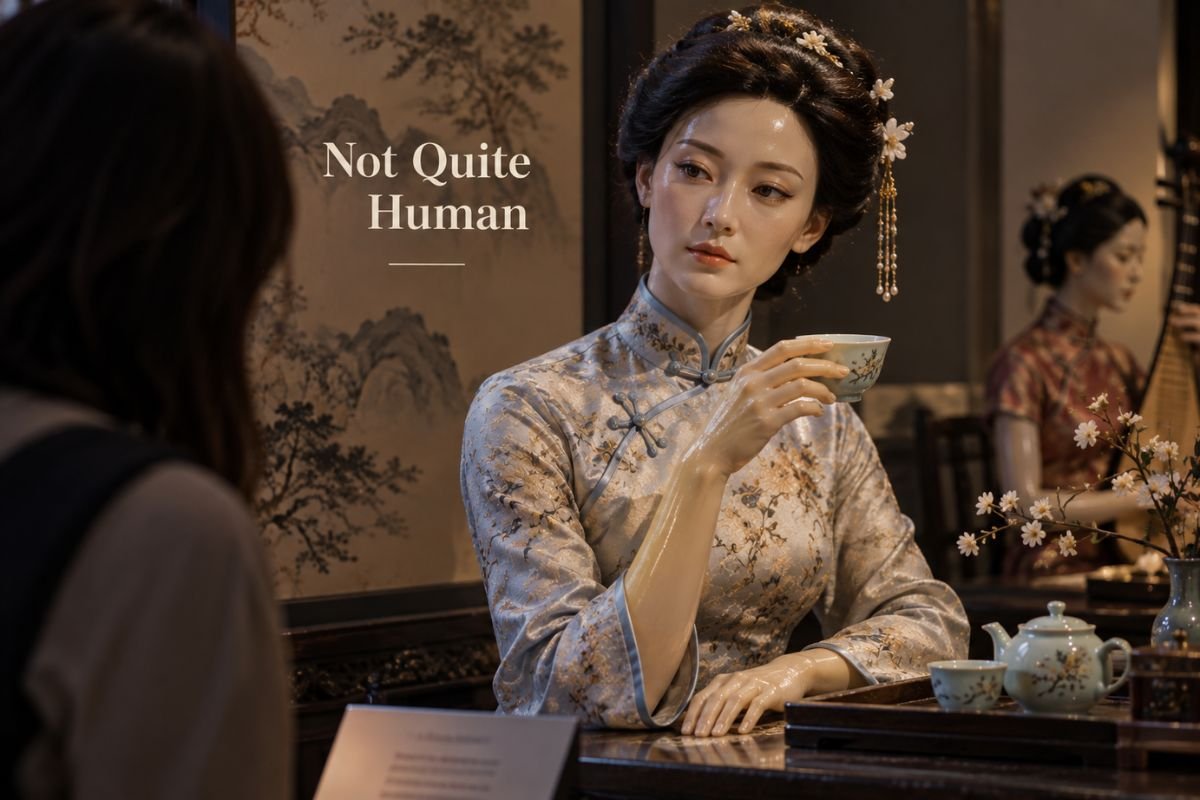
At first sight, the women sitting in Guest House: Welcome Home look oddly familiar. Look a little longer and it will become increasingly hard to identify who exactly they are. The familiar-looking faces are dressed in silk qipaos, enjoying tea, engaging in calligraphy, cooking using a wok and playing a traditional Chinese musical instrument.
These are lifelike wax sculptures made by Chinese artist Zhou Xuerong. This is her first institutional show in the United States, which opened at The Wang Contemporary in New York on September 11.
View this post on Instagram
While in most cases, artists tend to create celebrity likenesses out of wax, Zhou puts her figures into settings reflecting Chinese traditions and daily activities.
It means that the recognition of the faces is just the start of the viewing experience.
View this post on Instagram
Familiar Faces Hard To Identify
Guest House: Welcome Home includes ten life-size wax figures. They bear the resemblance of recognizable American women, but this is not the main idea of the exhibition.
Instead, these figures engage in six rituals and domestic activities like sipping tea, holding a calligraphy brush, cooking, having dinner, undergoing acupuncture treatment or playing the erhu, which is a traditional Chinese two-stringed instrument.
All the figures wear qipao.
By bringing the recognizable faces into a new cultural setting, the artist creates a unique visual contradiction. While on one hand, recognition allows viewers to understand something about these figures, their clothing, activities and surroundings make viewers think about something different.
The exhibition uses this ambiguity to go further than just identifying whether the lifelike wax sculptures look human or not.
Realism Creates Stranger Scenes
When an artist tries to recreate the appearance of a human being, wax is often a good choice as it offers special qualities of translucency and surface. It means that wax sculptures look quite different from sculptures made of stone, bronze or any other traditional material.
Zhou has been working with wax figures for more than twenty years, since 1999. In Guangdong, she creates hundreds of them through Grand Orient Wax Art. Making such a figure can take several months because of the combination of handcraft with 3D scanning and other contemporary technologies.
In Guest House, the level of realism of these figures is important since they should stand out.
While the stillness of the figures is easily visible, their faces, clothes and posture make them look so familiar that the domestic scenes seem really believable.
As they become closer to reality, their stillness becomes more noticeable.
The Qipao Adds Another Level Of Intricacy To The Exhibition
While the clothing could be considered decoration, the silk qipaos worn by the figures add another layer to the exhibition.
The garment has a complex cultural history as the qipao itself was developed during the Qing period, but then its shape was significantly changed during the early twentieth century, especially in Shanghai. Western tailoring techniques became a part of this development, changing the proportions and helping create the contemporary fitted look.
Such a history of cultural exchange naturally fits the exhibition that discusses the movement from one culture into another.
While the faces appear to move from one visual world to another, the clothes surrounding them tell the story of their adaptation and cultural exchange.
Lifelike Wax Figures Are Not Merely Celebrities
Realistic wax figures are usually associated with museums where resemblance is what brings people there. The satisfaction comes from standing close to a recognizable person recreated at human scale and checking how realistic the figure looks.
Zhou uses the power of resemblance in another way.
While resemblance is the way to create an initial connection, the surroundings of the figures destabilize it. Recognizable faces do not retain the same meaning after changing their clothes and activities.
It is also why the exhibition seems slightly disturbing despite the absence of any horror or spectacle. Nothing extraordinary happens. The figures stay there, looking almost human but completely still, engaging forever in moments that are normally transient.
Guest House: Welcome Home transforms the lifelike wax sculptures into something closer to frozen scenes rather than celebrity replicas. What makes these figures interesting is not only their resemblance to real people. It is how fast this resemblance disappears as the environment becomes strange.