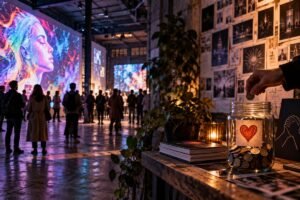
Imagine walking into a room where the walls seem to disappear behind moving landscapes and colorful digital imagery. There is no virtual reality headset to put on, and the experience isn’t confined to a screen you hold in your hands.
In Luoyang, China, an attraction known as Illusion Space (幻境空间) explores this approach to immersive entertainment. The venue was featured in a July 2026 report about digital tourism, describing an environment where projected images cover the walls, floor, and ceiling.
View this post on Instagram
What Makes Luoyang Illusion Space Different?
Rather than giving each visitor an individual display, the attraction creates a visual environment that several people can experience together.
The surrounding projections are central to the effect. Images can extend across different surfaces, making the physical room appear to contain spaces and scenery beyond its actual dimensions.
Unlike headset-based virtual reality, visitors can remain aware of the people around them while looking at the digital surroundings. That makes the experience something friends and families can share in the same physical space.
Digital Art You Can Walk Into
The attraction is part of a wider interest in immersive digital entertainment, where visual technology is used to create environments rather than conventional images on a single screen.
For visitors, the distinction is simple. Instead of looking at a digital landscape from a distance, they can stand within the space where that landscape is being displayed.
The experience also raises an interesting creative possibility: a room doesn’t have to change physically to look completely different. By changing the imagery projected across its surfaces, the same interior can take on an entirely new visual appearance.
Luoyang Illusion Space offers a glimpse of how digital imagery can become a shared experience, bringing the visual language of virtual worlds into a setting people can explore without wearing a headset.