From glowing projections on building facades to tiny electronic circuits that produce sound, Berlin New Media Week 2026 showed just how far digital art can travel beyond a computer screen. Held from September 2 to 6, the festival brought artists, technologists, musicians, and curious visitors together across the German capital, turning familiar cultural spaces into places for experimentation.
Now in its second edition, the festival explored a world where art doesn’t always hang on a wall or sit quietly behind glass. Sometimes it responds to a person’s movements, takes shape through sound, or spreads across the outside of a building. And in Berlin, a city with a long history of experimental culture, there was plenty of room for those ideas to unfold.
View this post on Instagram
When a Building Becomes Part of the Artwork
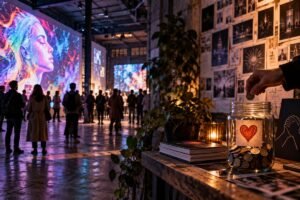
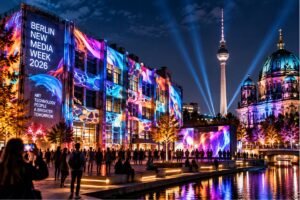
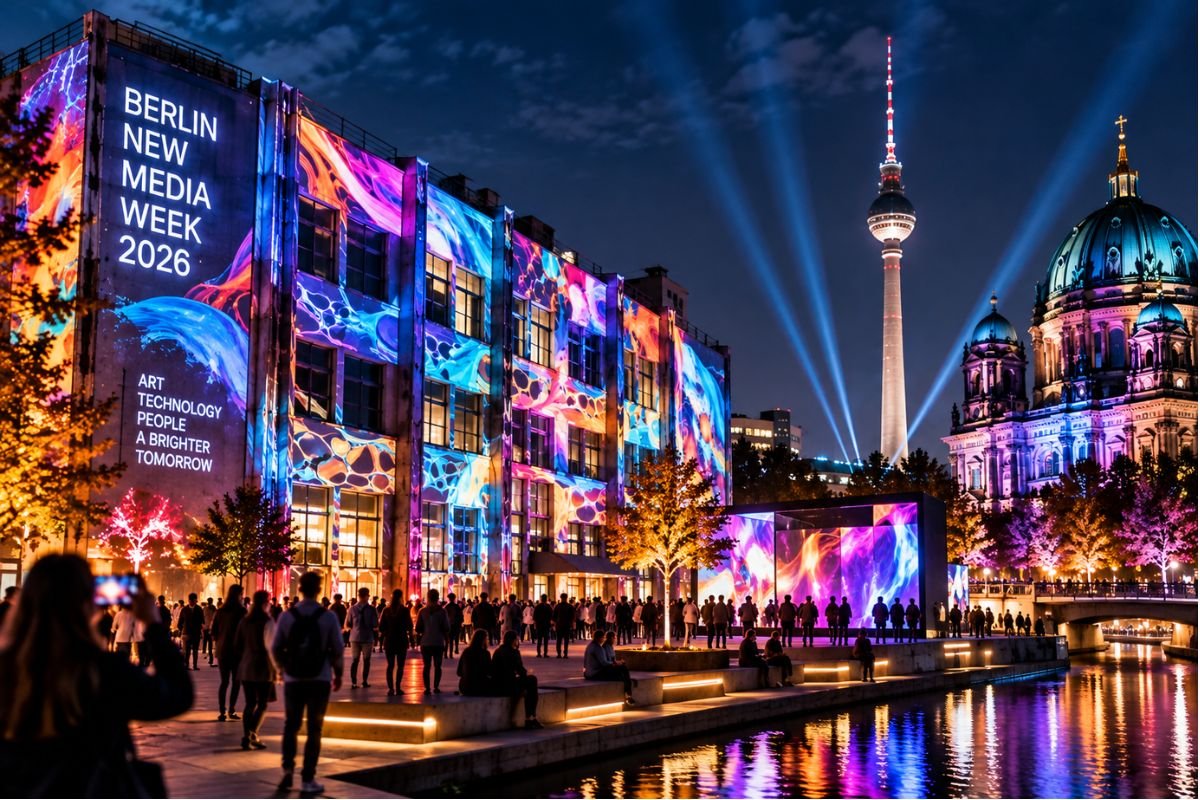
One of the most visually striking events took place on September 6 at LA18, a former factory building in Berlin’s Reinickendorf district. The venue hosted BYOB Berlin’s Plug and Play, a one-day multimedia exhibition featuring projections, installations, audiovisual performances, and large-scale projection mapping across its four-story facade.
Projection mapping uses digital imagery designed to interact with the shape of a physical surface. Instead of displaying a rectangular video on a flat screen, artists can work with windows, architectural details, and the contours of a building itself.
At LA18, the building became part of the visual presentation, with projected artwork extending the exhibition beyond its interior rooms.
The event followed the BYOB concept, short for Bring Your Own Beamer, in which artists bring projectors to share their work. The format dates back to Berlin in 2010, when artists Rafaël Rozendaal and Anne de Vries initiated the first BYOB exhibition.
For the 2026 gathering, the organizers expanded the concept to include other forms of new media art. The advertised program featured more than 60 international artists, including Rahul Sharma, alongside live performances and installations.
From Tiny Circuits to Live Audiovisual Performances
Not everything at Berlin New Media Week 2026 required an enormous projection or elaborate installation.
On September 6, the School of Machines, Making & Make-Believe hosted a workshop at LA18 where participants could build small electronic circuits and turn electrical signals into sound.
It was a particularly accessible introduction to the relationship between technology and creativity. Rather than simply watching an electronic artwork, participants could explore how a basic circuit produces something they can hear.
Earlier in the week, the school also organized an introductory session at ACUD for people curious about new media art, including those with no previous experience. The program invited participants to explore examples of the medium and consider what creating this kind of work might involve.
That hands-on approach reveals an interesting side of digital art. The technology doesn’t always need to be complicated for the experience to be engaging. Sometimes understanding how a sound is created, or seeing how an image responds to a physical space, is enough to make an unfamiliar medium feel approachable.
A Festival Spread Across Berlin
Unlike an exhibition contained within a single museum, Berlin New Media Week brought its program into different parts of the city.
The 2026 edition included galleries, cultural venues, and spaces associated with Berlin’s electronic music and experimental art communities. The opening event at THE_SPACE Kudamm introduced visitors to digital installations and live audiovisual performance, while other participating venues included Studio1111, DAM Projects, and LA18.
This distributed format gave different kinds of creative work their own surroundings. An audiovisual performance in a music-oriented venue offers a different experience from a projection installation on an industrial building, even when both use digital technology.
The festival also connected with IFA 2026, the Berlin technology exhibition, bringing selected new media programming into a wider conversation about emerging technology and creative practice.
Why Berlin New Media Week 2026 Was Worth Watching
What made the festival interesting was the variety of ways people could encounter digital creativity.
A visitor might watch images projected across a building, listen to an audiovisual performance, or learn how a small circuit generates sound. Each activity offers a different way to understand technology as a creative material.
There is also something appealing about seeing digital art in ordinary physical spaces. A building that normally serves a practical purpose can temporarily become a canvas, while an electronic component can become the starting point for a musical experiment.
Berlin New Media Week 2026 brought those possibilities together without requiring every artwork to look or behave the same way. For anyone curious about the relationship between art, play, sound, and technology, it offered a glimpse of how much creative experimentation can happen once the screen is no longer the boundary.