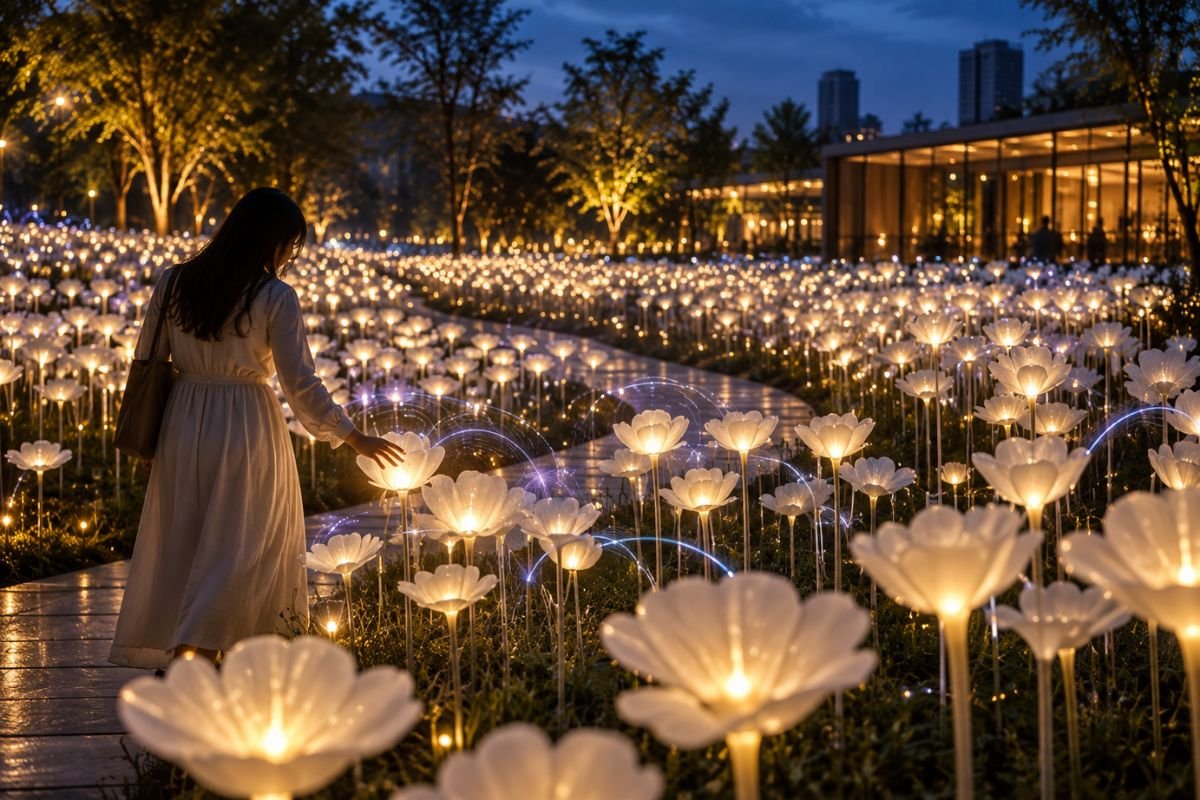
There is a white flower field in Osaka that does something quite peculiar in the evening. Instead of being just a part of the landscape, the flowers become responsive when someone approaches them, sending light and sounds all through the garden due to the presence of visitors.
The interactive flower installation is named Life is the Sea Flickering in the Dark, which is a 2026 piece by international art collective teamLab. The installation opened to the public on September 3 at teamLab Botanical Garden Osaka, which is a nighttime open-air museum located in Nagai Botanical Garden. The flowers used for the installation are Madagascar periwinkles in bloom during the early autumn season.
The Flowers Become Responsive to Someone Stopping Nearby
The interaction takes place unexpectedly. The visitors do not have to press any buttons, control the installation via a screen, or use special apps for that.
When someone gets close to the Madagascar periwinkles and stops for a while, the flowers light up and start producing some sounds. Then, other flowers become active one after another, making it possible for the light and sounds to travel across the field. Even wild animals roaming around the garden can cause such reactions.
View this post on Instagram
This means that people will be able to recognize another visitor or an animal coming in by the waves of light that move towards them. In other words, the installation depends on real-life events taking place there. There is no pre-set sequence that everyone would watch.
The people visiting the garden take part in shaping the picture of the field at that time.
An Interactive Installation Based on Live Flowers
What is quite peculiar about this installation is that it is not based on digital copies projected on a screen.
Madagascar periwinkles are plants that belong to the botanical garden. teamLab adds a bit of light and sound to make the installation complete but does not separate it from the living environment around it. As a result, it lies between the garden, light installation, and interactive artwork.
It also means that there is one more thing that needs to be taken into account when it comes to a natural installation: the natural life cycle of the plants.
The period of showing Life is the Sea Flickering in the Dark was set to last until September 27, covering the time when Madagascar periwinkles are in their best shape. The exhibition may vary according to the condition of the plants and might not be held during rainy and windy days.
The Garden Is Not Waiting for Someone to Change
The most peculiar thing about the installation is that it does not depend only on humans.
Wild animals can also cause the flowers to become active. The change in the field does not necessarily mean that it happened because another visitor appeared there.
In other words, there is a difference in the interaction. Instead of the idea of the garden being an interface that waits for someone to activate it, there are some actions taking place in the environment that make the installation change.
The visitor is actively participating, but is not controlling everything.
For an installation built around living flowers, this is quite right. The pleasure does not lie only in watching thousands of points of light appearing in the darkness. It lies in realizing that each wave represents something that is happening inside the garden.
For several weeks in the early autumn, flowers become a way of perceiving that.