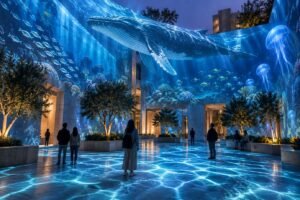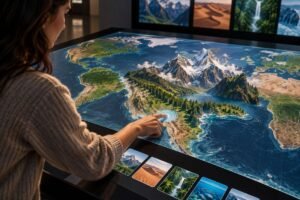
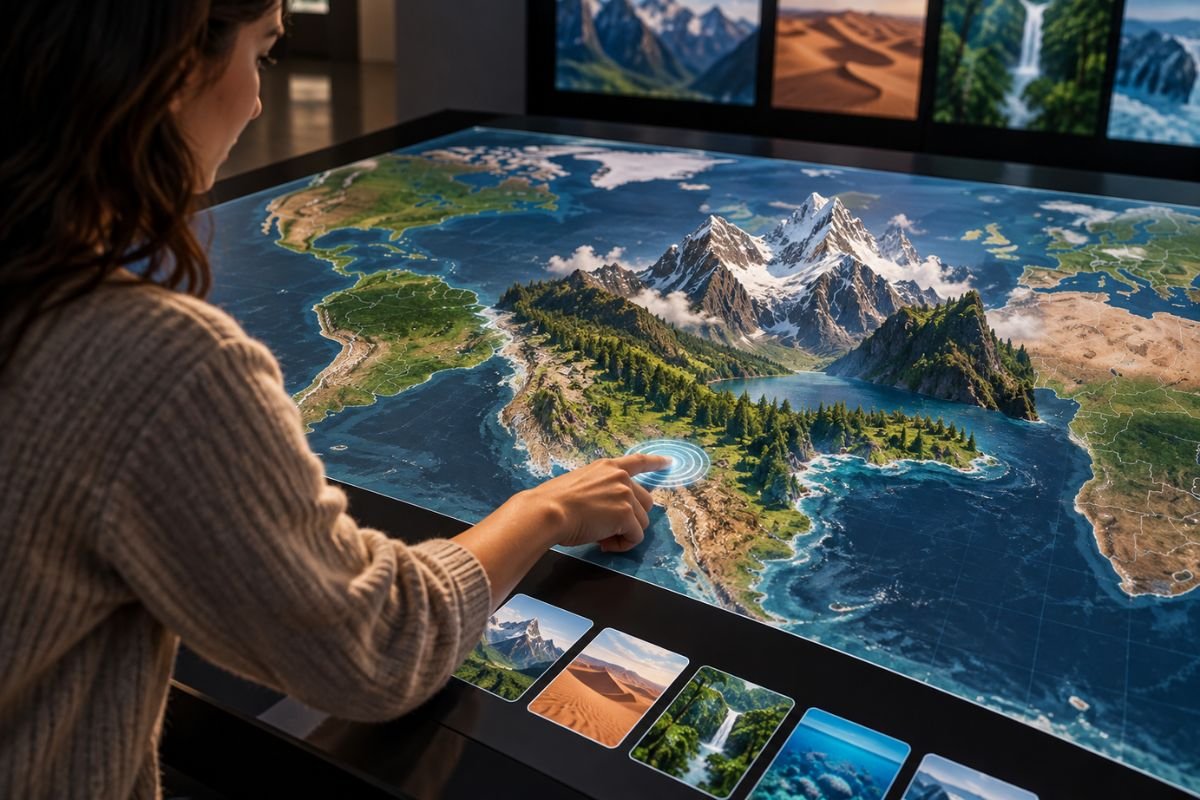
Geography is traditionally perceived as something presented through maps, photos and descriptions of lands that are not here and now. In the newly created room at the National Geographic Museum of Exploration in Washington, D.C., visitors are immersed in the landscapes they explore.
Geoverse is an interactive geography experience developed by the National Geographic Society together with Moment Factory. Starting June 26, 2026, the 270-degree theater with wrap-around projections, an interactive floor and spatialized sound provides the opportunity to experience geography as something surrounding the visitors.
Instead of concentrating on the locations of geography, the experience looks at the methods that are used by explorers to study places, find patterns and gather information.
Interactive Geography Experience Follows Real Explorers Through Field Research
One of the first programs of Geoverse, Geography in Action, shows the work of real explorers without moving visitors outside of the room.
In the seven-minute program, visitors move from the Peruvian Andes to the Okavango Delta in Botswana. The way field researchers study the landscapes becomes apparent to the audience.
Alongside the footage captured during the research, the presentation uses data visualization, typography and motion graphics. GPS tracking technology is introduced into the experience as well, creating connections between the landscapes on the screen and the tools used to explore information about them.
Thus, the locations become not just scenery but examples of the way researchers study places, patterns, layers, scale and time to explore the world.
Desert Landscape Turns into Interactive Playscape
Another program offered by Geoverse, A Day in the Desert, offers a slightly different approach.
Designed for children and families, the experience helps them explore the Great Victoria Desert in Australia using an interactive playscape. The plants and wildlife of the desert become part of the digital playscape where simple activities allow visitors to discover information about the desert in the course of moving through the experience.
This approach creates an important difference.
View this post on Instagram
The Geography in Action program lets visitors follow the work of explorers in real environments. A Day in the Desert requires visitors to take part in the investigation of the environment. The same physical room, therefore, becomes flexible enough to offer both storytelling and active investigation according to the chosen program.
This approach transforms Geoverse into a platform rather than a static museum exhibit.
The Room Itself Becomes a Tool of Learning
The design of the room allows the realization of the idea.
Images are able to surround visitors through the 270-degree projection surface rather than just showing up on a screen on the wall of the room. Spatialized audio lets sounds be placed in the environment while the interactive floor adds another interface for interaction.
These technologies are noticeable but not the main point of Geoverse.
Their role is to reduce the distance between the visitor and the information. A landscape surrounds the room. Data appears next to the imagery coming from the field. A child is able to learn about the wildlife of the desert by interacting with the environment rather than just reading a description of it.
The room also includes modular seating, closed captions designed and tested for the scale of the projections and the option to use an American Sign Language guide.
Geography Becomes a Way of Investigating the World
Perhaps the most important idea behind Geoverse does not have anything to do with the size of its screens.
National Geographic describes the process of geographic investigation through such concepts as place, patterns, layers, scale and time. Instead of just asking about the location of something, visitors are offered the opportunity to think about what is happening in the place and how the different pieces of information can help in exploring it.
Therefore, the role of the technologies becomes very clear.
Projections create the environment. The interactive elements encourage the exploration of it. However, the destination is not just the impressive digital landscape.
The interactive geography experience makes the process of closely studying the world tangible. There is no need to travel to Botswana, Peru or the Australian desert to start thinking as an explorer. The room is a temporary place for starting the investigation.