
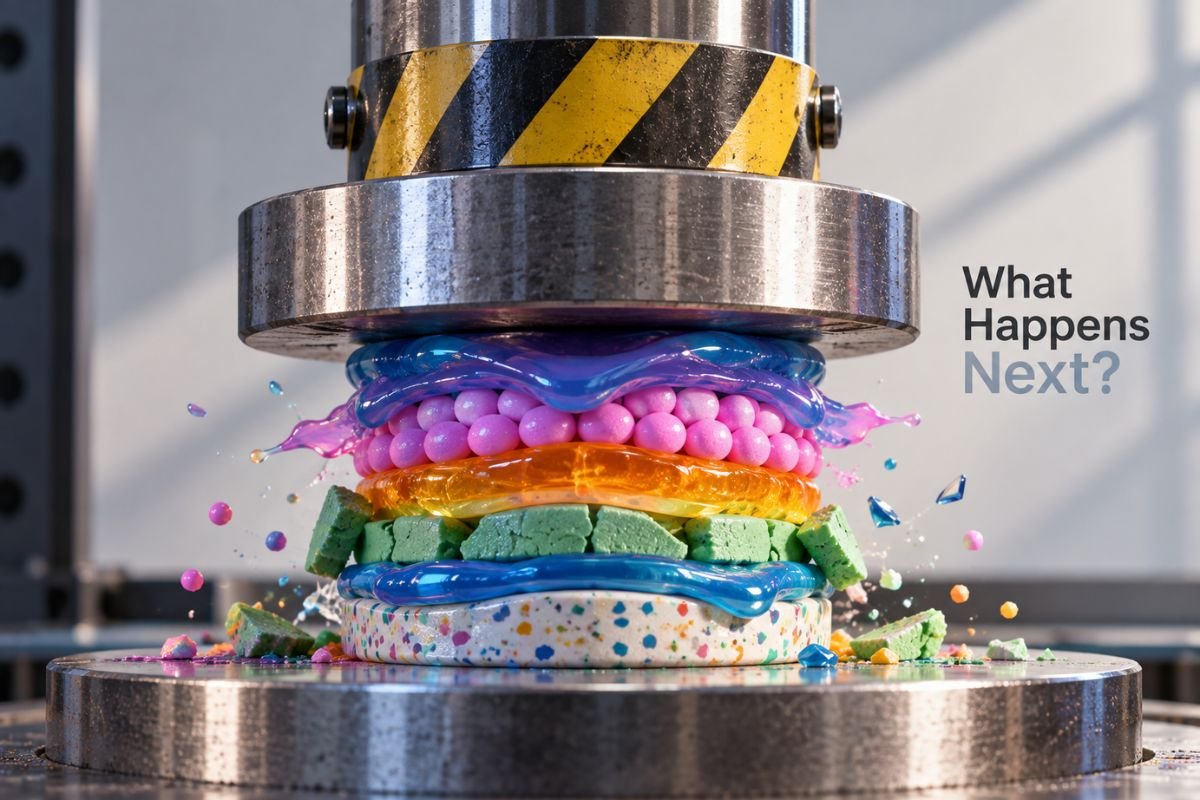
The concept of hydraulic press destruction is straightforward: place an item beneath the industrial press and witness the consequences. However, those consequences will differ significantly depending on the object.
An item can either bend or deform; porcelain will resist deformation until it suddenly cracks. Items can be squished or squeezed into different shapes depending on their consistency. It is precisely this element of uncertainty that has continued to fascinate people with hydraulic press experiments for quite some time now.
Same Press – Different Result
Hydraulic Press Channel has been crushing items using an industrial press since 2015, yet the format has evolved along with the items tested by the channel and the equipment used in those experiments.
Among those items were thick metal components, steel pipes, porcelain cups and even tightly packed toilet paper. In addition, 150-ton and more recent 300-ton presses have been used in experiments conducted by the channel.
In each case, it was not only the object that went under the press that made the difference.
Material defines the spectacle.
Brittle material can resist deformation and explode in a single instance. Deformation of metal can progress until it shatters. Soft materials can move sideways as the space between the press plates gets smaller.
It makes the moment before crushing particularly interesting. The predictability of the press contrasts with the unpredictable properties of the materials used.
View this post on Instagram
Familiar Items Help to See Changes
Crushing experiments using a hydraulic press become particularly impressive when dealing with items that are familiar to the viewer.
Any cup, pipe, piece of candy or other recognizable object gives the viewer a point of reference for comparison. The original shape is known to the viewer in advance, which makes all the further deformations easy to track.
The process is able to highlight features of the object that are hardly noticeable while looking at it on the table. The hardness, brittleness, flexibility and internal structure of an object become visible when witnessing its response to compression.
Sometimes the process ends with a sudden crack. At other times, the transformation happens gradually enough to witness the reshaping of the material.
Basic principles remain the same, yet the results can vary.
Hydraulic Press Destruction Is Still Alive
A decade after the start of Hydraulic Press Channel, new items are still placed under the press.
The longevity of the format can be explained by the minimal number of its components. There is the recognizable object, there is the force that approaches it and there is a result that is not predictable based on the appearance of the object.
There is no need for any complex setup for the viewer to understand what is going to happen next.
The fun is in figuring out how exactly it will happen.