Buildings traditionally show movement in terms of what goes on around them. People walk into and out of buildings; shadows appear and disappear and leaves blow in the wind. Kinetic building façades turn the traditional notion of movement on its head by giving the exterior of a building its own moving parts.
Some react to wind conditions. Others have mechanical or responsive components which modify their shading capabilities according to changes in conditions. While the resulting effect can be visually impressive, motion is not always employed purely to make a building look different.
Wind Makes the Wall Move
One of the simpler ways to achieve kinetic building motion does not require any motorization.
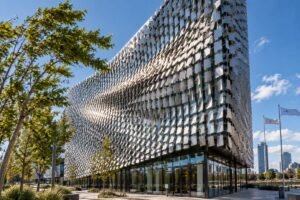
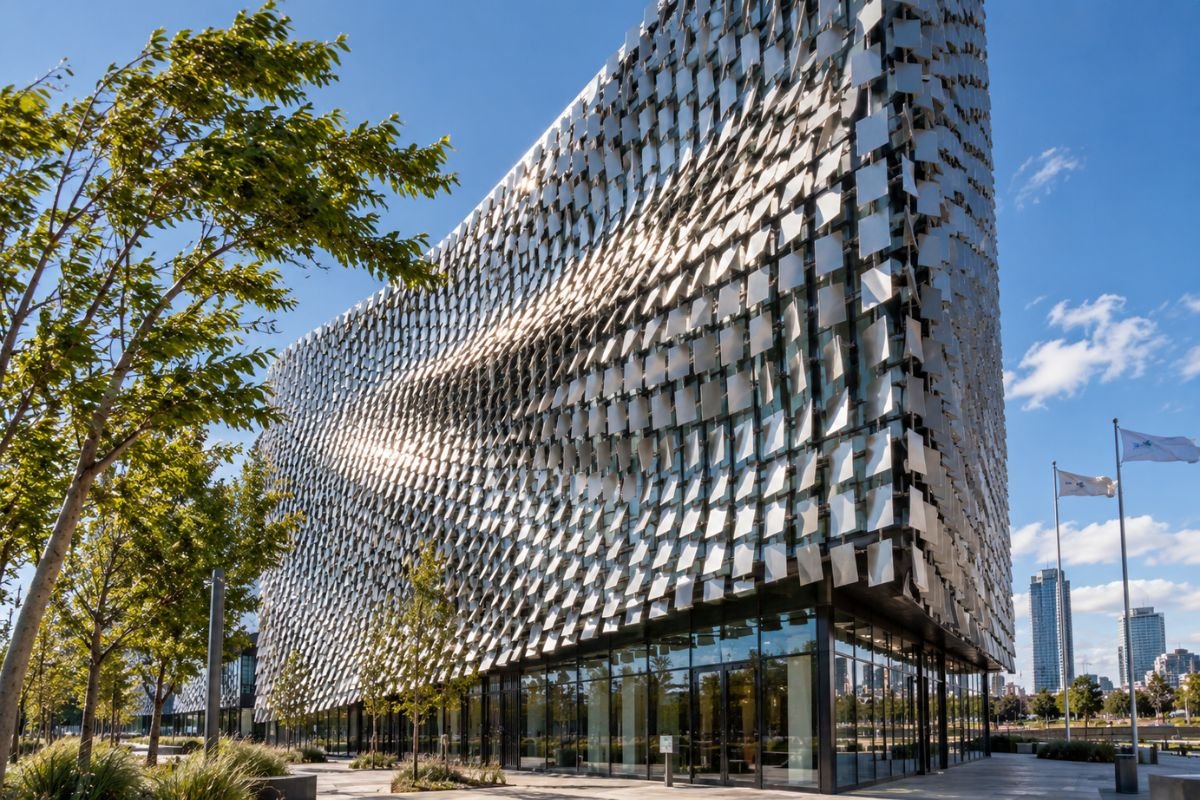
The Hawkeye Parking Ramp at the University of Iowa has a kinetic portion of the building façade made of 7,560 small pieces of aluminum fixed on 48 prefabricated panels. The motion is achieved through the action of wind currents which create ripples of movement on an otherwise stationary surface.
The motion is not always the same since the action of the wind dictates it.
This gives rise to an unusual combination of a rigid structure and the most variable element – the air. While the building only feels the breeze, now one can see the movement of air traveling along a portion of the building’s structure.
The moving façade also has functional importance. It allows air and light to pass through the parking structure from the outside.
A Moving Façade Manages Sunlight
A number of kinetic building façades move because of a different principle.
Instead of depending on wind to give individual pieces motion, the adaptive mechanism changes the building’s structure to control the amount of sunlight entering the building.
FlectoLine provides an interesting variation. The experimental façade system uses flexible composite modules which bend instead of conventional hinges. An example has been built outdoors as a full-scale demonstrator with 101 modules installed at the Botanical Garden in Freiburg, Germany.
The modules can open up to shade the building envelope, which allows it to adapt depending on the sun’s position.
It is necessary because just like the building, sunlight is not static. The angle of sunlight can change, weather conditions can change and so can the amount of daylight people find comfortable indoors.
View this post on Instagram
Researchers Explore Functional Aspects of Movement
Even beyond individual installations, functional aspects of kinetic building façades are being studied.
In 2026, research has been conducted into the influence of dynamic building façades on the quality of daylight, glare and energy performance of buildings. Simulation studies of an office building have shown that the proposed kinetic façade helped to reduce cooling energy consumption by about 35% as well as reduce glare.
Other recent research is looking into intelligent control systems which allow kinetic façades to adapt while managing multiple functions at once, such as daylight, visual comfort and energy efficiency.
What matters here is the fact that the façade of a building can now respond differently to changing conditions.
Architecture Does Not Have to Stay Stationary
Movement makes buildings feel different.
Hundreds of pieces fluttering in the breeze make a rigid structure look almost fluid. A shading system responds in a completely different way, altering the geometry of the building to control sunlight.
The methods are completely different, yet both challenge the notion that architecture has to be visually stationary after it has been constructed.
With kinetic building façades, a portion of the building continues to change after it has been constructed.